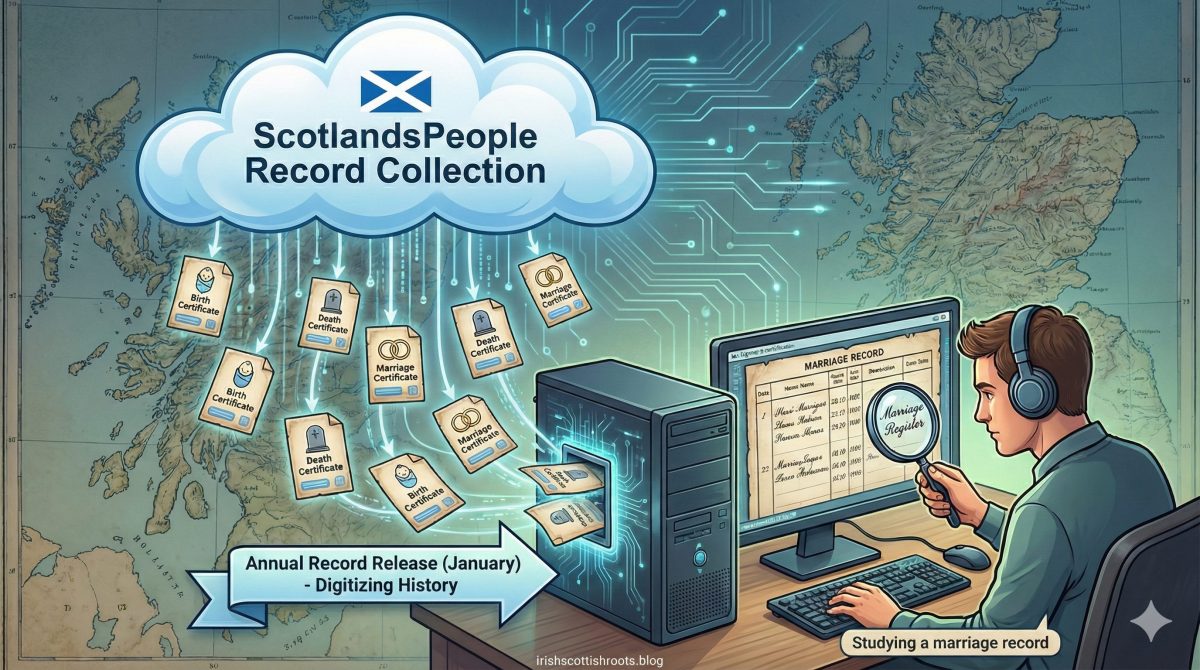

The 2026 ScotlandsPeople Release is the one week each year when Scottish genealogy suddenly feels easier. Fresh statutory records come online. Long-stuck research lines start moving again. Those “maybe someday” questions turn into “okay, let’s do this.”
If you want results fast, you do not need to search everything. You need the right order, the right filters, and a plan for borderline years.
The 2026 ScotlandsPeople rollout dates, and what just opened up
The National Records of Scotland (NRS) staggered the New Year rollout across three days in early January:
1925 births went live online on January 5, 2026.
1950 marriages went live online on January 6, 2026.
1975 deaths went live online on January 7, 2026.
That matters because ScotlandsPeople releases by record year, not by the exact day your ancestor was born, married, or died. So yes, someone born in early 1926 technically turns 100 in 2026. However, the 1926 register year will not open until the next annual release.
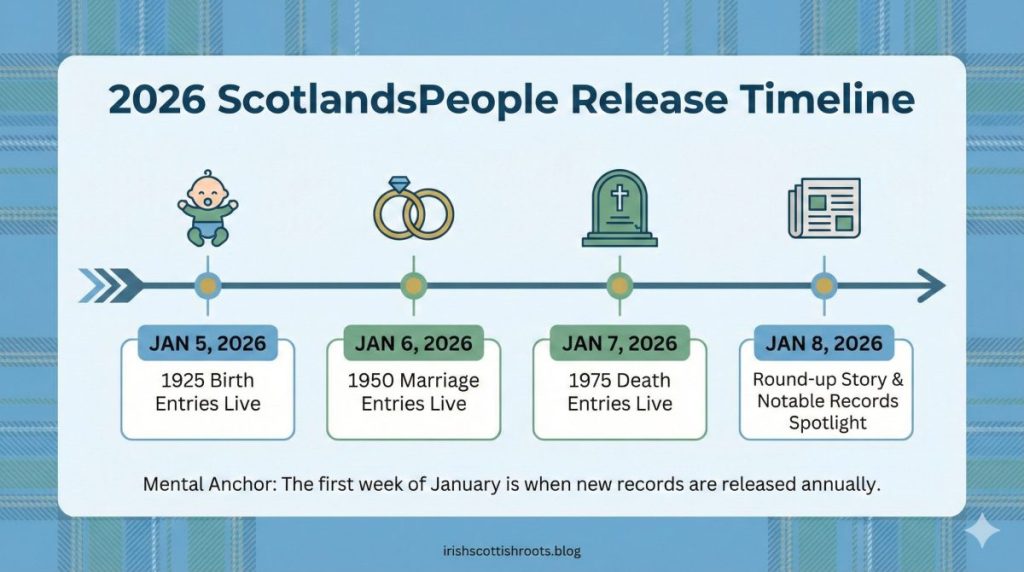
If your research calendar has a tartan highlight marker, this is what it was made for.
What the 2026 ScotlandsPeople Release costs, and how to keep it practical
ScotlandsPeople uses credits for viewing and downloading record images online. Searches in the index are the budget-friendly part, and the image views are where you spend.
A few practical cost truths will save you money:
Do not open images until the index result looks right.
Work in batches. Decide what you want to confirm first, then open only the best candidates.
Screenshot your notes separately from the image. You can avoid paying twice because you forgot to write down the entry number.

If you plan to visit Edinburgh, compare the cost of a full day at the ScotlandsPeople Center to the cost of multiple online image downloads. Sometimes the math is surprisingly cheerful, especially if you have a list ready to go.
What to search first, and why this order works
Here is the quickest win order for the 2026 ScotlandsPeople Release. This is especially useful if you are building families from the mid-1900s backward.
Start with 1950 marriages.
Then move to 1975 deaths.
Finish with 1925 births.
Why? A Scottish marriage entry usually hands you two sets of parents in one click. A death entry can confirm parents and often anchors a spouse. Then births help you lock in a mother’s maiden name and tighten the timeline.
That is the genealogical version of tying the knot before you unspool the yarn.
Step 1: Search 1950 marriages first, because they connect two families
The 1950 marriage entries are the best “bridge records” in the 2026 ScotlandsPeople Release. They sit in the ideal range. Here, names, occupations, and family structure often appear clearly. Many researchers still have living memory to compare against.
1950 also tells a story. Scotland was settling after the Second World War. Couples who had postponed marriage during wartime service surged in the late 1940s. The pattern of post-war settling still shows in 1950. Many of the people marrying in 1950 became parents of children born in the 1950s and early 1960s. This is why these entries can feel like the “baby boomer parents” dataset.
ScotlandsPeople even highlights the color of the year. One featured entry is the September 1950 wedding of Prince Georg of Denmark and Anne, Viscountess Anson. It was held at Glamis Castle in Angus. It is a reminder that statutory records capture every kind of story, from royal guests to the couple down the street.
Your fastest marriage search strategy
Use this practical flow:
Begin with what you know, even if it is messy. A surname, a rough place, and “about 1950” is enough.
Search the index first. Do not spend credits yet.
Add a spouse surname if you have it. This is the quickest way to separate ten John Smiths from the one you actually want.
Then narrow by county or city, especially for Glasgow, Edinburgh, Aberdeen, Dundee, and Lanarkshire. Big places create big result lists.
Finally, open the image only when the index details look right.
If you are not sure whether the marriage was registered in 1950 or slipped into early 1951, search both years. Registration lag is real, and it loves to ruin your confidence.

Step 2: Use 1975 deaths to confirm parents and clean up identities
Next, use the 1975 deaths to confirm the “right person” problem. Death entries are fantastic in several scenarios. They are helpful when you have common names or repeated family first names. They also assist when two cousins seem to share the same life.
The 2026 ScotlandsPeople Release includes the 1975 death entries. ScotlandsPeople’s own coverage points out that the January release opened hundreds of thousands of images across the three categories. That scale is exactly why you need a plan. Without one, credits disappear into thin heir.
A notable 1975 example mentioned in the NRS coverage is rugby player Arthur Robert Smith. He grew up near Castle Douglas in Dumfries and Galloway. He died at age 42. You might not be researching him. However, the example is useful because it shows how a death entry can close the loop on a life. This spans rural origins, education, career, and family.
What you should pull from a 1975 death entry
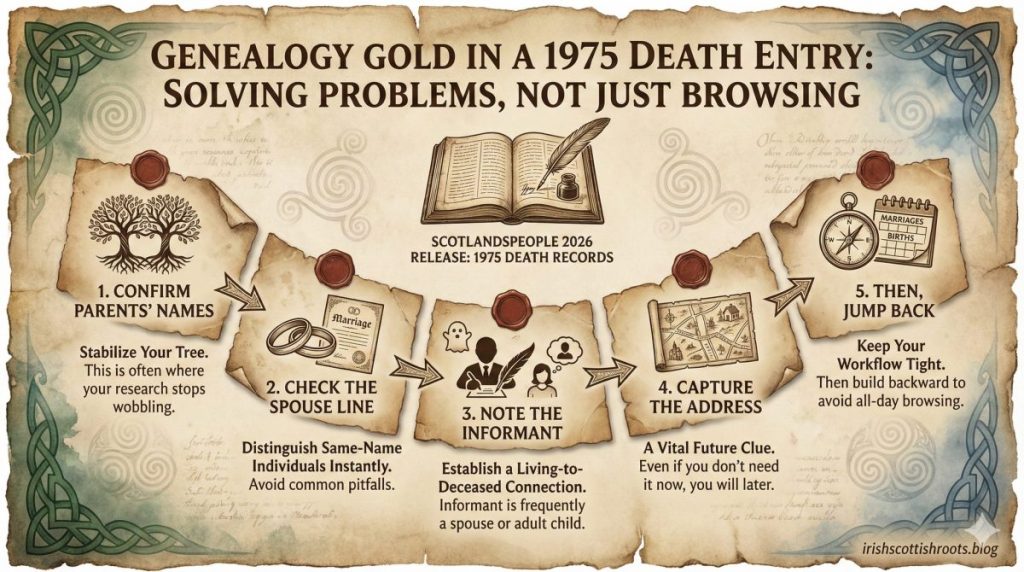
When you open the image, look for details that solve problems, not just details that feel interesting.
Confirm the deceased’s parents’ names. This is often where your tree stops wobbling.
Check the spouse line. It can distinguish same-name individuals instantly.
Note the informant. The informant is frequently a spouse or adult child, which gives you a living-to-deceased connection.
Capture the address. Even if you do not need it now, you will later.
Then, and only then, jump back to marriages or births to keep building. This keeps your workflow tight and keeps the 2026 ScotlandsPeople Release from turning into an all-day browsing session.
Step 3: Use 1925 births to unlock maiden names and place-based clues
Once you have marriage and death anchors, 1925 births can lock in mothers’ maiden names and precise places. This is where your research starts feeling “grounded,” because births often pull you into specific streets, villages, and districts.
Also, 1925 births are perfect for identifying the grandparents generation in many modern family trees. If your parents or grandparents were born in the 1940s or 1950s, a 1925 birth entry may belong to an older sibling. It could also be a parent or an aunt or uncle. This record helps you confirm the family structure.
Here is the practical twist. When you sit right on the cutoff, registration year matters more than the birthday.
People born late in December 1925 but registered in January 1926 won’t be in the newly opened 1925 set. So search both 1925 and 1926 in the index. Even when the image is not available yet, the index can still help you identify the entry you need.
Privacy cutoffs, in plain English, and how to handle borderline years
Most people describe ScotlandsPeople privacy using simple rules:
Birth images open after 100 years.
Marriage images open after 75 years.
Death images open after 50 years.
That is the right idea, but the practical reality is more “calendar year” than “birthday exact.” The New Year release is a year-based unlock. So borderline problems show up in two common ways.
First, the “they are old enough, but the year is not open yet” problem.
Second, the “registered next year” problem.
Here is how you handle both without frustration.
Borderline strategy 1: Search the index across the boundary
Do not search only 1925. Search 1924 to 1926.
Do not search only 1950. Search 1949 to 1951.
Do not search only 1975. Search 1974 to 1976.
This catches late registrations, transcription issues, and simple family memory errors.
Borderline strategy 2: Use the ScotlandsPeople Center when online access is blocked
If you hit a record that sits inside the closed window online, you still have options.
You can order a certificate extract through official channels.
Or you can plan a research day at the ScotlandsPeople Center in Edinburgh. On site, you can access digitized records and modern records that you cannot view online. This is especially useful when your research is focused on the mid-to-late 1900s.
This is also a great option if you want a focused “download day.” You can grab multiple records in a single session. This helps keep your home research tidy.
A first-hour plan for future release weeks
If you sit down with a future ScotlandsPeople Release and want progress fast, use this one-hour structure.
First 10 minutes: Build a target list of 5 to 10 people, with estimated years and places.
Next 20 minutes: Search the release year’s marriages in the index for each couple, and narrow with spouse surname and district.
Next 20 minutes: Open only the strongest matches, and capture parents, occupations, and addresses.
Final 10 minutes: Jump to the release year’s deaths for the same surnames and places, and confirm parents and spouse details.
If you still have time left, then move to the release year’s births to lock in maiden names and confirm the earlier generation. Otherwise, stop. Finishing with a clean set of confirmed facts is better. It beats opening “just one more record” until your credit balance looks like it fell off a cliff.
If you are researching from outside Scotland
You can run this whole strategy from anywhere, as long as you stay disciplined about the index-first approach.
If you are building a plan for heritage travel, our post Explore Irish and Scottish Heritage from Home can help you. It can turn records into a practical itinerary. This way, your research time doubles as trip planning.
Get the next release guide in your inbox
If you want practical Scotland and Ireland research travel ideas, subscribe to irishscottishroots.blog.
Recent posts you might like:
- Bamburgh Castle – History and Genealogy Insights
- Jedburgh Abbey Visitor Guide – History, Highlights, Tips
- Unusual Stays in Scotland – 3 Routes Worth Detouring
- Holy Loch Submarine Tenders – A Cold War Scotland Story
- Irish, Scottish, and American Health care: who pays
All images in this article were generated by Google Gemini, unless otherwise noted.
Terry Donlan is the founder of Irish Scottish Roots and has researched his Irish and Scottish family history since 1985. He has made five research trips to Ireland and Scotland and writes about genealogy, heritage travel, historical records, and the people and places that shaped Irish and Scottish family stories.
Discover more from Irish Scottish Roots
Subscribe to get the latest posts sent to your email.